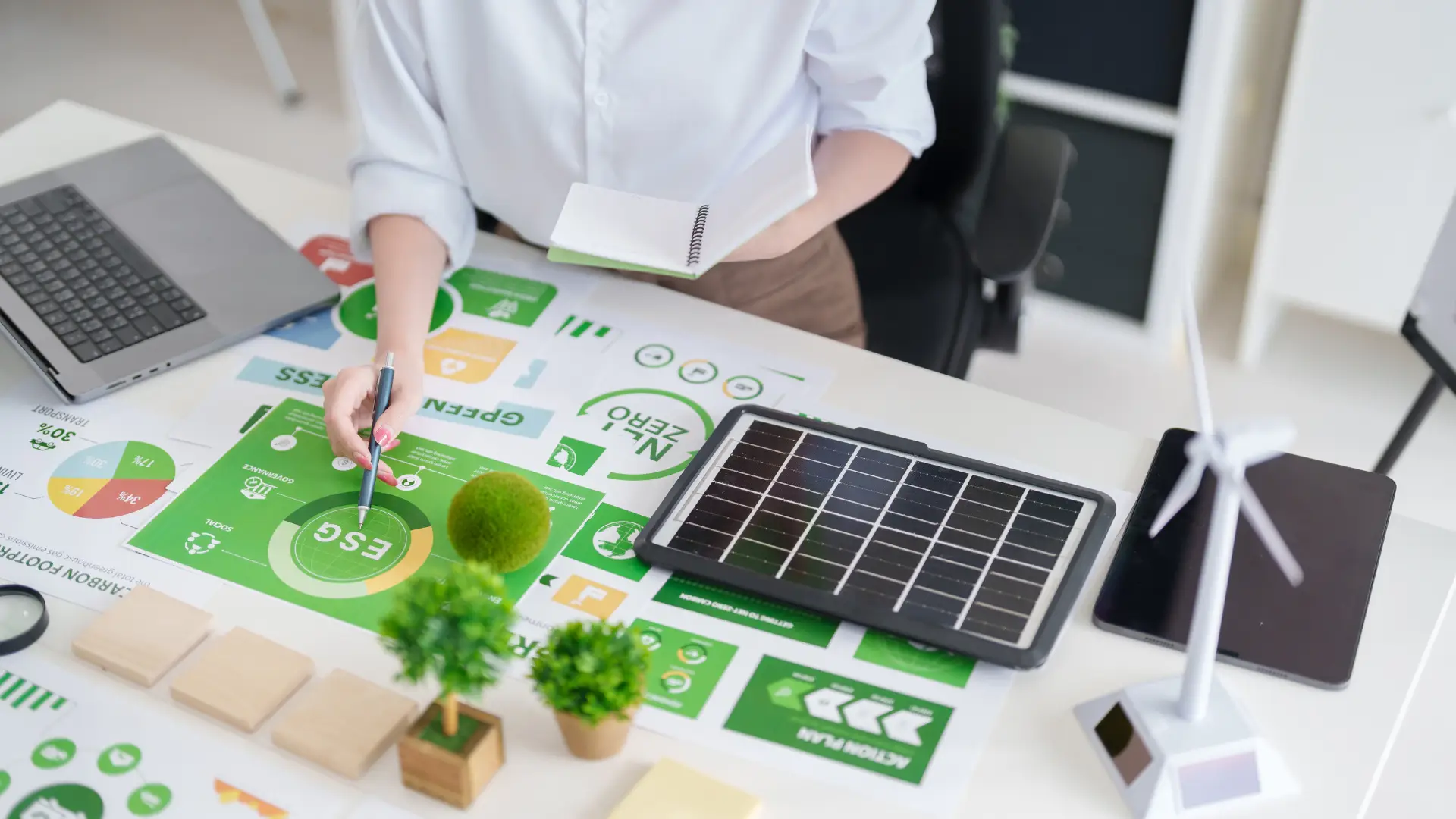

What do you think of when you picture a green business? Is it an organic grocery store, complete with reusable hemp bags? In reality, green businesses come in many shapes and sizes, spanning sectors from manufacturing through to warehousing.
No longer just the domain of social enterprises, green business practices are now becoming the standard across the UK, especially in light of commercial carbon reporting requirements.
Let’s get into what organisational environmental responsibility is, benefits (both to your business and the planet), and practical measures you can take to reduce your company’s environmental impact.
What Is a Green Business?
A green business is an organisation that is conscious of its carbon footprint and general environmental impact. In the long run, it is on a sustainability journey to reduce carbon emissions and implement sustainable practices at every level of business operations.
Green business considerations are one part of the environmental, social, and governance (ESG) framework, though of course all three are interlinked. After all, you can use ESG principles to understand not only how your business affects the environment but also the knock-on impact on your people and your local community.
Take a manufacturer that invests in modern, energy-efficient equipment. Yes, it will cut energy use and carbon emissions, but in the process it could also create a safer or more comfortable working environment for employees.
Benefits of Sustainable Business Practices
You might think that implementing a green business model is only beneficial for the environment, but this is not the case. Sustainable practices can mean long-lasting success for your business as well as long-lasting positive benefits for the environment. This can look like:
Lower carbon footprint
The most obvious benefit of reducing your business impact on the environment is, of course, a lower carbon footprint. According to the Corporate Health Check 2026 report by CDP, companies with leading environmental strategies are reducing emissions around four times the annual rate of other businesses. Their strategies may include measures such as generating renewable energy, improving energy efficiency, and reducing waste to help cut emissions over time.
Resource and cost savings
Sustainable practices and healthy profit margins can go hand in hand. Why? When you use less energy, fuel, or raw material, you are not only reducing environmental impact but also cutting the amount your business has to pay for those resources.
Commercial solar is a good example. Eden Farm partnered with Perfect Sense Energy to install a 729 kW solar PV system that is forecast to cover around a quarter of the site’s annual energy consumption and deliver £141,500 in first-year savings, with an estimated four-year payback period.
Competitive advantages
Customers are increasingly paying attention to the environmental and ethical credentials of the businesses they buy from. In fact, 85% of consumers say they have been negatively affected by climate change, so despite cost of living pressures, they are willing to spend a 9.7% premium for sustainable products.
Showing that your business is taking meaningful environmental action can therefore help strengthen your reputation and give customers another reason to choose you. That being said, greenwashing won’t cut it. The key is to back those claims up with genuine progress rather than vague sustainability messaging.
How to Become a Green Business

1. Measure your carbon footprint.
Before you can reduce your environmental impact, you need a clear picture of where you are starting from. Look at sources such as the electricity and gas you use, fuel consumed by company vehicles, business travel, waste, and emissions associated with your supply chain.
The Greenhouse Gas (GHG) Protocol provides widely used standards for measuring corporate greenhouse gas emissions, while the UK government publishes updated conversion factors each year to help businesses turn activity data, such as electricity or fuel use, into carbon dioxide equivalent (CO₂e).
2. Cut the energy your business wastes.
You don’t necessarily need a major infrastructure project to start reducing your environmental impact. Walk around your premises and look for obvious areas of energy waste, from heating or cooling empty rooms to lights and equipment running when nobody needs them.
Reducing unnecessary consumption can help lower both emissions and energy costs, while also reducing your reliance on energy generated from fossil fuels. From there, you can explore longer-term solutions such as LED lighting, smarter controls, more efficient heating systems, and upgraded equipment.
3. Look beyond your own premises.
Your environmental footprint doesn’t stop at the front door. The products you buy, materials you use, freight you commission, and other businesses in your supply chain can all contribute to your wider emissions (known as Scope 3 emissions).
Start by identifying the suppliers and purchased goods that are likely to have the greatest impact. You can then ask suppliers for environmental information, choose sustainable materials or recycled materials where appropriate, improve recycling, and look for ways to send less waste to landfill.
4. Set clear environmental targets.
Once you know where your emissions come from, turn that information into a plan. Instead of a broad aim to simply “be greener”, set measurable goals, such as reducing electricity consumption by a certain percentage, cutting fleet emissions, increasing recycling rates, or working towards net zero emissions by a set date.
5. Generate your own electricity.
Once you’ve reduced unnecessary energy use, you can look at how you source the electricity you still need. Commercial solar panels allow businesses to generate renewable power on site, reducing the amount they need to buy from the grid and helping cut the emissions associated with purchased electricity.
Green Business Case Studies
Of course, it’s all well and good to talk about the theory of sustainability, but here are some UK businesses that set an example of what it can mean to be part of the green economy.
Toast

Image Courtesy of Toast Brewing
Let’s take an example of how creative recycling can become part of the business model itself. London-based Toast Brewing has built its business around a simple idea: turn food waste into something useful. The brewery replaces around 25% of the malted barley in its beer with surplus bakery bread, which reduces waste while cutting demand for the land, water, and energy needed to produce more barley.
That circular approach continues after brewing too. Toast sends spent grain for animal feed and composts spent hops, while its wider carbon strategy includes a shift towards lower-carbon packaging such as cans and kegs. Since 2016, the business has used the equivalent of 3.9 million slices of surplus bread and cut its emissions per litre of beer by 12% compared with 2019.
Zen Internet
Zen Internet is another good case study for how a greener business model can support both sustainability goals and long-term cost savings. With Perfect Sense Energy’s design and installation, they implemented a commercial solar PV system to help the business generate more of its own electricity and rely less on grid power.
The system has generated around 188,500 kWh of clean electricity in the first year alone, with projected savings of more than £24,300. Over 25 years, it is also expected to save an average of 66 tonnes of carbon per year, with a projected payback period of just 3–4 years.
Get Commercial Solar Panels With Perfect Sense Energy
If you want a greener business, solar panels make perfect sense. Unlike some sustainability measures which may cost your business (for example, hiring a recycling company to process waste), commercial solar panels can actually save your business money. With an average ROI of only 3-4 years, sometimes less, they could be the sustainable energy bill-saving solution you’re looking for.
With Perfect Sense Energy, you can rest assured that your commercial solar panels will be designed to your precise building specifications and positioned to maximise energy output.
Try our free solar calculator and see how much your business could save:
What type of building are you looking to install solar for?
Please note, as a commercial installer, we are unable to offer solar for individual residential properties.
Start typing the first line of your business address here:
Draw a polygon on the map by clicking on corner of your roof.
Analyzing your roof area…
Where can we send the information to you?