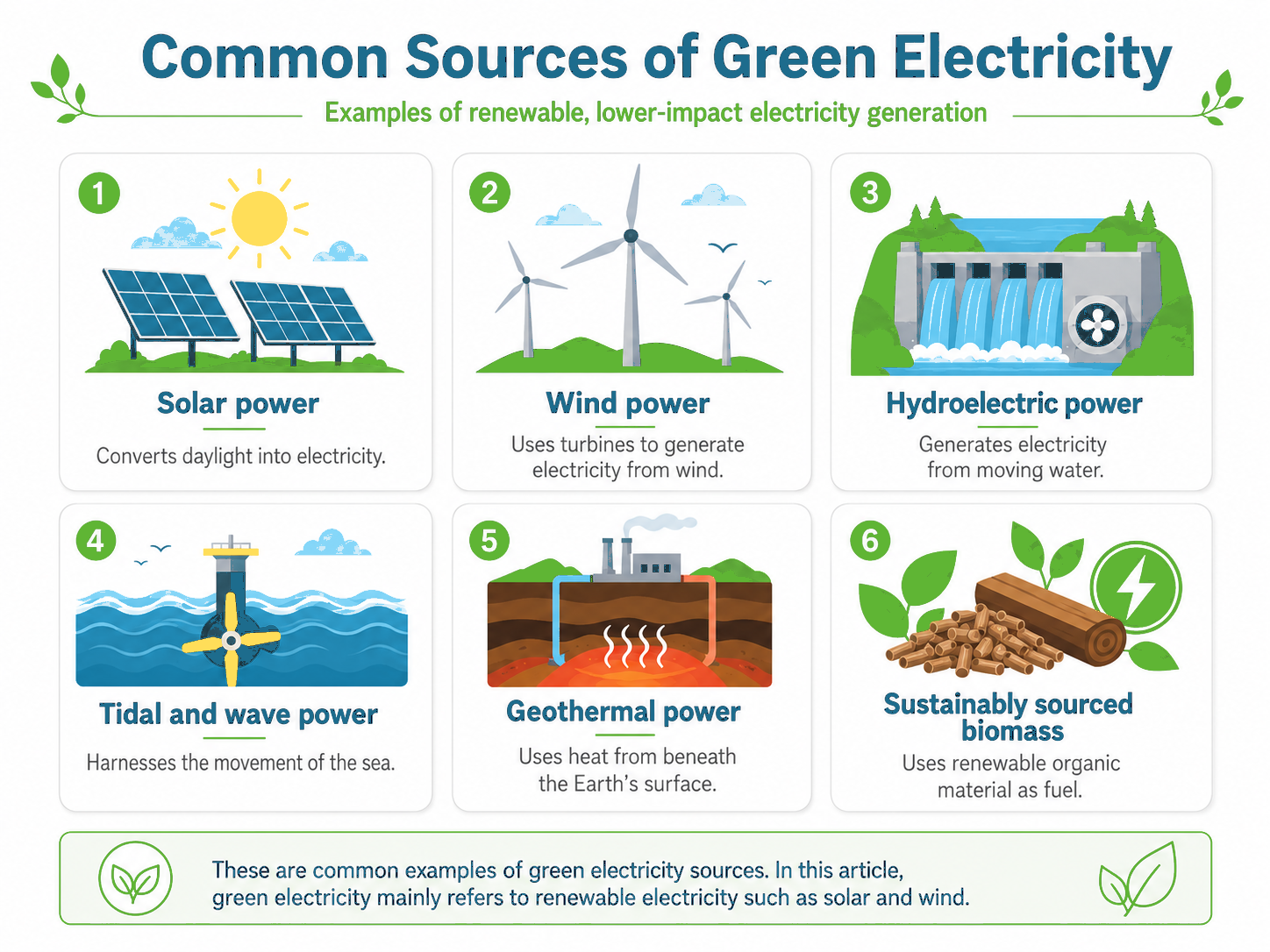


The world’s biggest household names aren’t waiting for new laws or grid miracles; they’re already powering every laptop, forklift and server rack with renewables.
Why should smaller businesses care? Because the same playbook that got Apple and Google to 100 % green electricity now comes in off-the-shelf packages any company can afford. The ten stories below show what “doing it” really looks like, and which ideas you can swipe today.
Apple
In April 2018, Apple announced that all of its global facilities are powered by 100% renewable energy, including retail stores, offices, data centres, and co-located facilities in 43 countries.
- What they did – Switched every store, office and data-centre to renewables, then leaned on 320+ suppliers to follow suit. Apple now backs over 18 GW of clean power across the globe.
- Why it matters – Apple shows that even an energy-hungry hardware maker can get suppliers on board.
- Try this – Bundle purchasing power with your suppliers; negotiate a single solar-or-wind deal that covers you all.
Google (Alphabet)
In 2017, Google achieved its goal of purchasing enough renewable energy to match 100% of its global annual electricity consumption, including data centres and offices.
- What they did – Became the first large company to match all its annual electricity with renewables and has done so every year since. Now shooting for 24/7, hour-by-hour clean power by 2030.
- Why it matters – Matching in real time is the next frontier; annual offsets will look old-fashioned soon.
- Try this – Ask energy suppliers for “time-stamped” renewable certificates so you know when the clean power is produced.
Amazon
Amazon met its goal of matching 100% of the electricity consumed by its operations with renewable energy in 2023, seven years ahead of its original target.
- What they did – Hit 100 % seven years ahead of target by bankrolling 500+ wind and solar farms and buying Renewable Energy Certificates (RECs) to close the gaps.
- Why it matters – Even fast-growing firms can keep up with demand if they build projects early.
- Try this – Lock in long-term Power-Purchase Agreements (PPAs) before you need the power, not after.
Meta
As of 2020, Meta (formerly Facebook) achieved net zero emissions and powered its global operations with 100% renewable energy.
- What they did – Cut operational emissions 94 % by feeding every data-centre and office with renewables, then offsetting the tiny remainder.
- Why it matters – Data-centre owners prove that the biggest electric loads can still go green.
- Try this – If you’re in a heavy-use building (warehouses, servers), partner with local utilities to create a “green tariff” rate.
Salesforce
In September 2021, Salesforce announced that it had achieved net zero residual emissions across its full value chain and 100% renewable energy for its global operations.
- What they did – Now sells its own carbon-tracking software to customers.
- Why it matters – Turning sustainability into a product line can pay for the journey.
- Try this – Treat your internal tracking spreadsheets like a future revenue stream: build once, sell later.
T-Mobile US
T-Mobile achieved its goal of sourcing 100% of its total electricity usage with renewable energy by the end of 2021.
- What they did – First U.S. wireless carrier to cover 100 % of its electricity with renewables—through eight virtual PPAs plus dozens of community-solar deals.
- Why it matters – Virtual PPAs let you support new wind/solar without owning sites.
- Try this – If your HQ isn’t sunny, finance a project where it is and apply the renewable credits to your bill.
Unilever
As of January 2020, Unilever’s factories, offices, R&D facilities, data centres, warehouses, and distribution centres worldwide are powered by 100% renewable grid electricity.
- What they did – Every site now runs on renewable grid electricity, backed by onsite solar in 23 countries.
- Why it matters – Global manufacturers can still act locally by boosting the grids they rely on.
- Try this – In multi-country operations, start with markets where green tariffs already exist; use savings to fund harder locations.
Swiss Re
Swiss Re has maintained 100% renewable electricity use for its operations every year since 2020, utilising solar installations, virtual power purchase agreements, green tariffs, or high-quality renewable electricity certificates.
- What they did – Re-insurer switched all offices to renewable power and set an internal carbon price to drive deeper cuts.
- Why it matters – A carbon price inside your P&L makes every team think twice about fossil energy use.
- Steal this – Add a “shadow” carbon cost to project budgets—even a notional £50/t can sway purchase decisions.
Goldman Sachs
Since 2020,Goldman Sachs sources electricity equivalent to 100% of its global consumption from renewable sources, aiming to source 80% of its renewable energy from long-term, impactful agreements.
- What they did – Sources renewables equivalent to 100 % of its worldwide electricity consumption and ties new office builds to green standards.
- Why it matters – Finance firms are moving first because investors now ask “show me your clean-power receipts.”
- Try this – Publish your energy mix in annual reports; transparency builds investor trust.
Iron Mountain Data Centers
Since 2017, Iron Mountain Data Centers have been powered by 100% renewable energy, providing sustainable data center solutions across three continents.
- What they did – All colocation facilities on three continents run on renewables; now piloting tidal power for true 24/7 clean energy.
- Why it matters – Mid-sized companies don’t have to wait for giants; partnerships (like tidal tech) can give you an innovation edge.
- Try this – Offer customers a “Green Power Pass” or similar certificate so their sustainability teams can claim the benefit too.
Final Thoughts
These ten brands prove that clean power isn’t a PR dream. It’s a practical business decision that cuts risk, locks in long-term pricing and wins customers. Whether you start with a single rooftop array or a shared power-purchase agreement, the trick is to start now and scale fast!
Ready to put the theory into practice? Talk to Perfect Sense Energy about a tailor-made solar solution for your site and start generating your own clean, low-cost electricity.
Research methodology
| Step | What I’ll do | Why it matters |
| 1. Define the bar | “Using 100 % renewable electricity” means the company publicly reports that all Scope 2 (purchased electricity) for its global operations is met with renewable sources or matched annually with RECs/PPAs. Hour-by-hour, 24/7 matching is noted but not required. | Keeps criteria clear and comparable. |
| 2. Source candidates | Start with the RE100 progress table (members marked “100 % achieved”) plus Fortune Global 500 and S&P 500 sustainability leaders. | Quickly surfaces verified claims. |
| 3. Verify achievement (2024–25) | Check the latest sustainability report or newsroom release for each candidate. Cross-confirm with independent coverage (Reuters, FT, Forbes) where available. | Avoids outdated or aspirational claims. |
| 4. Filter for “top” status | Keep companies with 2024 revenue ≥ US $10 bn or outsized sector influence. | Ensures the list feels genuinely “corporate-scale”. |
| 5. Document & date-stamp | Capture a permalinked source for each claim and note the year first achieved. | Provides audit trail and lets us refresh easily later. |
FAQs
1. What does it mean to run a business on 100% renewable electricity?
Running a business on 100% renewable electricity means sourcing all electricity needs from wind, solar, hydro, or other renewable sources, either directly or through instruments like Power Purchase Agreements (PPAs) and Renewable Energy Certificates (RECs) that offset conventional grid use.
2. How can small businesses afford renewable energy like large corporations?
Small businesses can access renewable energy affordably through shared PPAs, green tariffs, and community solar programs. These models allow them to benefit from clean energy without upfront capital or owning infrastructure, similar to how major companies scale their strategies.
3. What’s the difference between annual matching and 24/7 renewable energy use?
Annual matching offsets a year’s worth of electricity with renewables over time, while 24/7 matching ensures clean energy is used every hour of the day. The latter is more precise and reflects real-time energy sourcing, offering stronger climate credibility.
4. Why are companies investing in renewable electricity before it’s legally required?
Businesses adopt renewables early to stabilise long-term energy costs, reduce climate risk, and appeal to investors and customers. Proactive adoption also prepares them for future regulations and builds a competitive sustainability advantage.
5. Can office buildings and data centres fully switch to renewable energy?
Yes, offices and data centres can run entirely on renewables through on-site solar, utility partnerships, and clean energy procurement. Even high-demand facilities can operate sustainably with proper planning and supplier collaboration.