
The UK’s solar market has the power to grow exponentially over the next few years. Though a solar farm might put you in the mind of a farmer setting up a farm on the sun, maybe even in a 1950s-style space suit, the reality is slightly different.
Solar farms can also be called solar parks, solar power stations, or even photovoltaic power stations. “Farming” sunshine is a bit of an odd concept, but it has very real and practical use. Let’s take a look at solar parks, some of the real-life examples currently supplying us with energy, and the benefits of building them.
What is a solar farm?
A solar farm is a large collection of photovoltaic panels, otherwise known as solar panels, usually put together to generate large amounts of electricity. This electricity is then used either by businesses near the farm or fed into the National Grid. Companies that require a lot of power for their facilities then do not have to worry about putting significant strain on power systems during times of high demand.
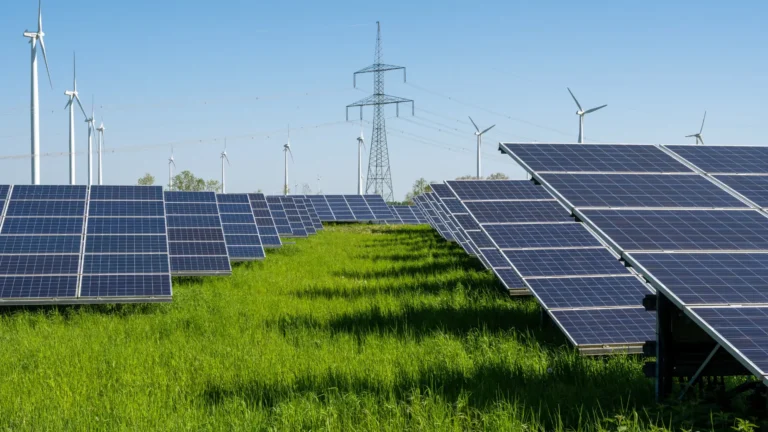
Currently, the cumulative installed capacity of the UK’s solar power is approximately 15.8 GigaWatts (GW). The government wishes to increase this drastically over the next decade to achieve an output of 70GW by 2035, which is in line with decarbonisation targets. Much of this will be done using commercial solar panels and solar farms.
Solar farms are sometimes compared to concentrated solar power (CSP) arrays as both make use of solar energy. However, they are not the same. CSP projects are usually an array of mirrors or lenses which concentrate sunlight into a receiver. This is then converted to thermal energy which is fed to a heat engine such as a steam turbine and used to power an electrical power generator. This is different from a solar farm, which uses photovoltaic cells.
These solar cells convert sunlight into an electric current without first having to turn it into heat. Both systems carry their own benefits but solar farms greatly outnumber CSP stations. Let’s explore the two main types.
What are the types of solar farms?
There are two types of solar farms currently widely used in the UK. Both will use the electricity they make in the same way; they will either (1.) direct it towards a specific business for commercial use or they will (2.) feed it back into the National Grid to be used by commercial and residential properties. The types of solar farms are:
Utility-scale solar farms
Utility-scale solar farms are large-scale projects such as the installations at Shotwick. While Shotwick does power a specific factory nearby, the energy generated by the solar PV cells in the park also goes to local residential properties. The majority of large-scale UK solar farms are likely to be this style: private infrastructure used to support businesses in the local area.
Case Study: Shotwick Solar Park

One of the largest solar parks in the UK can be found at Shotwick Solar Park in Wales. It is located close to the UPM paper manufacturing plant and provides the factory with approximately 60% of its energy needs. Currently, the park has a capacity of 72.2 Megawatt peak (MWp).
The park has a projected life of approximately 30 years. With the farm covering 220 acres of land, it currently produces over 68,000 MWhrs of renewable energy, saving nearly 16,000 tons of CO2 emissions(*). When it has reached the end of its life, it will be dismantled and the land can either be repurposed or allowed to turn back to its natural state.
With new sites under development across the UK, Shotwick may not be the largest any longer, but it will continue to serve as a testament to how successful solar farms can be.
Community solar farms
Unlike utility-scale solar farming, which sees businesses purchase from a private solar farm, community solar farms are owned by the people in the community. When the panels in these arrays generate electricity, it is directly fed to the homes and businesses in that local area. The energy may even be used to power a specific building in these local communities, such as schools or council buildings.
Investing in solar technologies may even become an option for communities in future who want to become more sustainable together.
Case Study: The island of Eigg

A great example of a community solar farm can be found in the Scottish island of Eigg, who use solar energy as part of their renewable energy scheme to power the homes and businesses on the island. The island was bought by the community trust in 1997 and multiple projects have since been undertaken to rejuvenate local infrastructure.
The solar project on Eigg offers 170kW in capacity and works in conjunction with their hydro and wind schemes to offer a total capacity of 300kW. Each house has a maximum use limit of 5kW at any one time, and each business gets 10kW. The system on the islands is sufficient to power the island with no input from a mainland facility and even generates excess at times.
Where can you build solar farms?
Part of the issue of large-scale solar energy projects such as these is that they require a lot of land. After all, most solar farms sit on sites that can stretch over acres. Though the aim is to repurpose the land after the solar farms have been decommissioned, there are still concerns that the solar industry is not necessarily the best use of this land.
Another factor that has to be considered is simply public perception. Many are of the impression that solar farms are an eyesore. They do not want to have to look at scores of solar panels, even if it is a viable renewable energy source. Since most large solar farms need to go on rural land, simply to meet space needs, there are concerns that the solar panels will ruin these beautiful, natural, rural landscapes.
Community solar farms have a little more flexibility in where they can be placed. So long as they are in an open area with a clear view of the sky, expert fitters should be able to install solar panels securely on buildings or in other small areas of land that might otherwise go unused.
Can you mix solar and traditional farming?
Some groups have expressed concern that moving towards solar farming could use up valuable land currently used for the traditional farming of agriculture. Obviously, we need to ensure that we hold back high-value fertile land for food production, but that does not mean that farmers and other groups cannot pursue solar farming too.
Many areas of land in the UK could potentially be adapted for dual purposes. As an example, livestock such as sheep can be grazed alongside a solar farm with little to no danger. There are also fewer emissions with a solar farm compared to a traditional power plant. Solar panels don’t emit smoke—if they do, something has gone very wrong!
There is no reason why farmers cannot explore diversifying through solar power, and vice versa with solar farmers interested in adding traditional farming to their output.
One of Perfect Sense Energy’s agriculture customers opted to add solar panels to the roof of their farm shop to help reduce costs and improve their energy efficiency—find out more here.
Is sunlight an issue?
Yes, bright sunlight is needed for solar panels to work at maximum capacity. As anyone familiar with the UK’s weather knows, sunshine isn’t always guaranteed. However, that should never mean that we just write off solar power as useless. Solar panels will still generate electricity even on the cloudiest of days. We can even use solar panels to generate energy in winter, so we shouldn’t consider a lack of sunlight to be a reason why we cannot have solar farms.
Though other countries might get more sunlight and, therefore, harness higher wattages from their farms, UK solar farms will still be able to give good returns to the businesses and communities they support.
The future looks bright with solar power!
The UK government aims to reduce dependence on energy sources that produce carbon emissions and move us towards a greener, more sustainable future. This will require us to diversify our approach to solar energy, whether that comes from the construction of more large-scale solar installations like Shotwick, or smaller community-led arrays like those helping to power Eigg.
We are here to help businesses of all sizes reach their sustainable goals. With government backing and growing interest in renewable energy, there’s never been a better time to invest in solar power. Let Perfect Sense Energy help you make the switch.