
As we head towards the darker half of the year, not just from longer nights but also from overcast weather, you might find yourself wondering whether or not solar panels will work in the winter months.
Let’s just get this out of the way first:
YES!
Yes, your solar panels will continue to work in winter. Is it as simple as that? Of course not! But if you want a quick and easy answer, we are happy to let you know that, yes, your solar panels should continue to work in winter.
If you want to know more about the intricacies of how solar panels work in winter, keep reading. We’re going to walk you through some of the complexities of whether the winter months will affect solar panel performance and what that can mean for you.
Why do solar panels work in winter?
Yes, as we said above, a solar panel system will indeed work in winter. However, it is understandable that most solar panels are not going to work as efficiently in winter as they might in bright seasons like summer. Understanding how solar panels generate energy helps us to know a little more about how they work in winter.
As you might know from our blog explaining what a solar panel is, solar panels generate electricity when photons in sunlight hit the photovoltaic cells in the panels. Photons are present even in the weakest of sun rays so, even on a very overcast day, you should still be able to see a little power being generated.
So yes, all we need is a little daylight for electricity generation. Though the winter days in the UK might be short, and overcast weather can make them feel dark even at noon, photons can still be captured in a solar panel.
Do solar panels work when it is dark?
Solar panels produce electricity even on extremely overcast days, but what about when it is fully dark, like at night? With those long winter nights (and more of a need to heat and light our homes in the cold dark!), it would be convenient if solar panels could work in the dark, wouldn’t it?
Well, night is the absence of sunlight. Due to our planet’s rotation, some of it has to be facing away from the sun, and other countries can enjoy their sunlight hours while we rest and prepare for the day ahead. If there is no sunlight, there are no photons to be converted into energy, and therefore solar panels won’t work.
But, you might ask, what of moonlight? Moonlight is nothing more than reflected sunlight, so surely there must be some photons in it? Yes, and no. Since it is not true sunlight shining on the panels, they are never going to be as efficient. Given how many cloudy nights we see in winter, we might not even see any moonlight at all! Many solar panel systems also come with a “night mode,” where they essentially go to sleep until dawn. So even if we see a bright and moonlit night, the panels might not be awake to register it!
The other question to ask is, can we make solar panels that work in the dark? Some development is underway to harness not the photons in moonlight, but the infrared radiation expelled from the Earth’s crust. The Sun heats the crust during the day, and this energy is just expelled into space at the moment. The infrared panels currently in development would look to harness this energy instead. These panels are obviously not going to be the same as solar panels, but they still represent an interesting step forward in the world of renewable energy.
Do solar panels work in bad weather?
We’ve established that solar panels do indeed work in winter, but not at night, but what about during bad weather? Winter can often bring storms, high winds, heavy rain, and other difficult weather conditions. It is understandable why you might want to know if your solar PV panels will work during a dark winter storm.
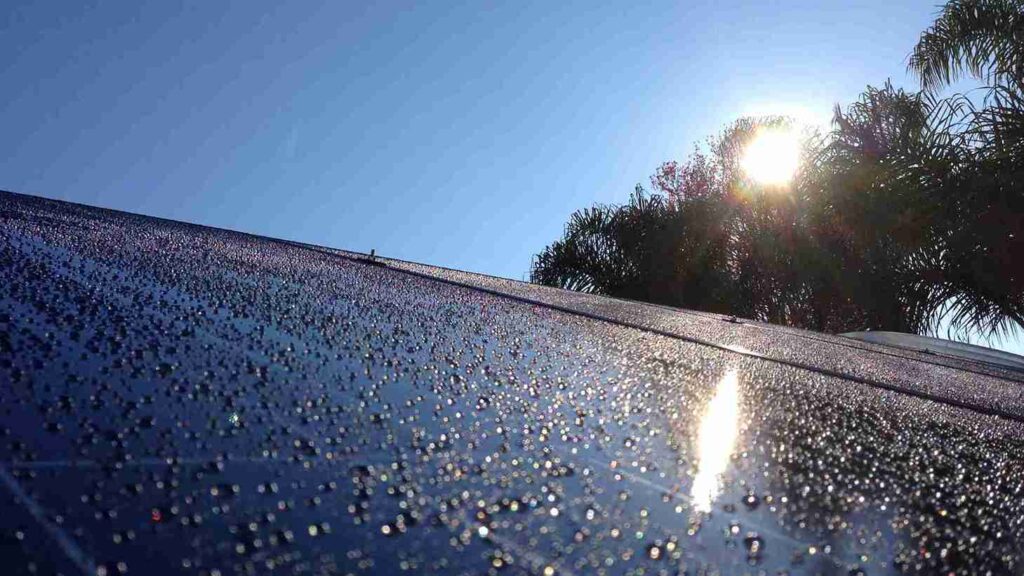
When it is raining hard, there is likely to be little natural light due to the heavy cloud cover. Though the efficiency of solar PV panels will be greatly decreased, there is a chance that they will still generate electricity in small amounts.
If properly mounted, rain should also just run straight off the solar cells. Rain will give your panels a good clean, and that is pretty much it. When the rain stops and the cloud cover breaks, you should notice a big uptick in your solar panel efficiency.
Are solar panels safe in high winds?
A big concern for many might be how solar panels will fare in high winds during a winter storm. Solar panels are designed to be hardy and durable and many can handle winds of up to 140mph (about that of a category 4 hurricane!). So long as the mountings and fixings meet standards, your panels are not going anywhere.
There is a chance that an object can collide with solar panels after being picked up by high winds. Falling tree branches and other debris could also damage solar panels. This is why the positioning of your solar array is the key; you need to make sure that it is away from trees and other objects that could cause an issue in high winds. In the event of a collision, only one or two solar panels will likely be broken and the rest will still function as normal until you can replace the broken ones.
Do solar panels work when it snows?
Winter doesn’t just bring dark and stormy weather, it can often also bring snow! There is a small issue here since solar panels rely on sunlight to produce energy. If they are covered in a layer of snow, the photons in sunlight cannot reach the panel’s cells.

This, again, can be fixed with the right positioning for the solar array. Never install solar panels so they lie flat. They should always have a small inclination to help efficiently capture sunlight. This will also help light snowfall to simply fall off the panel. If you have a heavier snowfall, you might need to clear the panels and roof to stop the heavy weight of snow from impacting your building.
Do solar panels work in cold temperatures?
Even if you have clear skies and bright sunshine day in and out, temperatures will drop in winter. The great thing about solar panels is that they actually become more efficient in colder weather. If you remember from our explanation of how solar panels work, the electrons in solar panels work to create the current that generates electricity. In colder temperatures, these electrons are at rest. When they are hit with the high energy of a sunbeam, there is a greater change between their rest and active states, resulting in more voltage and a higher output!
It is one reason why solar panels work so well in the UK. We might not get weather as sunny and warm as other countries, but our cold weather really benefits energy production when we need it!
Do I need to pack my solar panels away during winter?
You might think that solar panels are a bit like your garden furniture; great for the long summer evenings but better off in storage for the winter. This isn’t true! First things first, installing solar panels is a serious business where the panels are secured to your roof; you shouldn’t be able to just pick them up and move them!
Remember, solar panels still work even in poor weather or low light. They are very durable and can still produce some results even on dark days. What’s more, solar battery storage can help out if you have a power cut due to a winter storm. While your neighbours wait for their connection to the National Grid to be restored, you can maintain some power on your property thanks to your solar panels.
Talk to us about commercial solar panel installation today
Solar power is proving time and time again to be a great option for businesses of all sizes. Our customers cover enterprises of all sizes and across multiple industries. As we move into an era of renewable energy and green solutions, now is the perfect time for you to look into what a solar panel system can offer your business.
Don’t let yourself get fooled by common misconceptions like solar panels don’t work in winter, as we have shown above they very much do! We’ll even help you out with your maintenance needs so you can be certain your panels are productive all year round.