

Renewable energy is a big topic at the moment and for a good cause.
Three-quarters of global greenhouse emissions result from energy consumption, leading to alarming consequences, including rising global temperatures, unpredictable weather patterns, and loss of species across the globe.
We are all looking for ways to reduce our carbon footprint, which makes it essential that we look to renewable energy sources, such as solar power and wind power, to fuel our homes and businesses and reduce carbon emissions. These natural resources can be converted into several types of clean, usable energy to power the UK and beyond.
In this article, we look at some UK renewable energy statistics to understand our energy consumption, how it’s powered, and the future of energy production in the UK.
What is renewable energy?
The majority of electricity in the national grid is currently sourced from natural gas, a largely imported fossil fuel that emits carbon dioxide into the atmosphere when burned and contributes to rising greenhouse gas emissions. Renewable energy comes from sources that don’t generate these harmful emissions and instead produce clean energy.
There are four main renewable sources, which made up nearly half of the UK energy mix in 2025: wind power, solar power, hydroelectric power, and bioenergy. This consisted of 37% wind, 8% bioenergy, 2% solar power and 2% hydropower in the UK’s overall energy mix.
2025’s UK total electricity generation by source
Wind, solar, bioenergy, and hydropower all generate energy, which is converted into electricity to power UK homes and businesses. EdenSeven data reports that, on average, wind produced the largest proportion of the UK’s renewable electricity in 2025, at 37%, followed by biomass at 8%, solar at 2% and hydro at 2%.

In December 2025, wind was the UK’s largest source of generation, providing 37.8% of our electricity. 67% of electricity came from zero-carbon sources, peaking at 91% on 9 December at 3:30 am, according to NESO’s Great Britain’s monthly electricity statistics.
The growth of renewable energy sources
Renewable electricity generation has been growing over the years and is providing an increasing proportion of the United Kingdom’s power usage. By the end of 1991, renewables accounted for just 2% of all electricity generation in the UK. By 2013, however, this figure had risen to 14.6%. In 2025, renewable energy generation accounted for 47% of the UK energy mix. This was a growth of 7% from the previous time period.
The decrease in non-renewable energy
As the output of renewable energy rises, the production of primary fuels is decreasing, falling by 2.5% in 2024. Output from coal, nuclear, bioenergy, and natural gas was all reduced during Q3 of 2024, though oil output did increase, as reported by the Department for Energy Security and Net Zero.
Wind power generation in the UK
The UK is home to the world’s largest offshore wind farm, currently Hornsea 2, located off the coast of Yorkshire, with a combined total capacity of 1.32 gigawatts (GW).
According to government data, most offshore wind activity is in England, and around half of onshore wind activity is in Scotland. As of January 2026, RenewableUK’s EnergyPulse tracking shows there are 2,225 offshore wind projects globally, and 7,492 onshore wind projects in the United Kingdom.
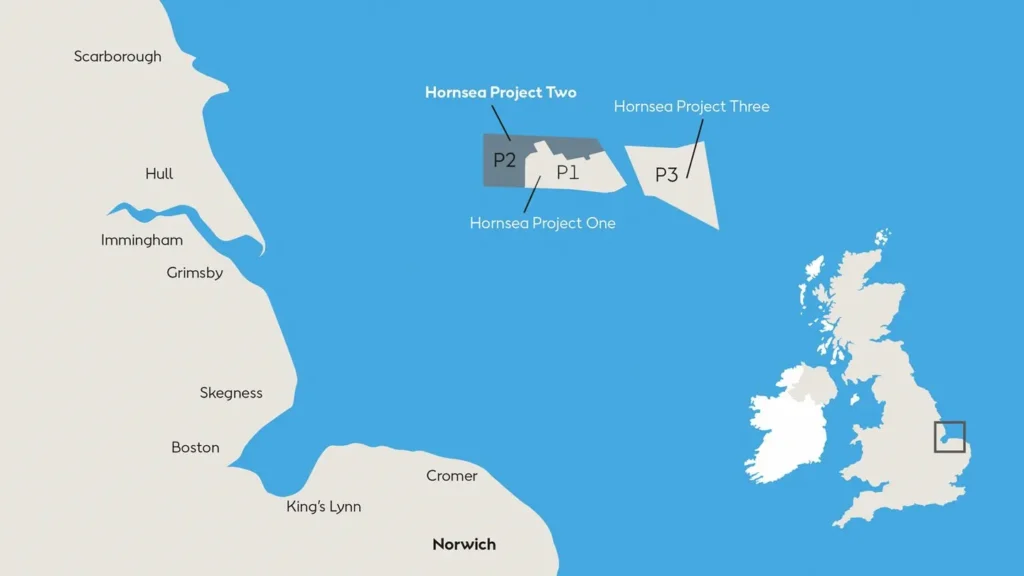
Image courtesy of Orsted Energy
Recently, the United Kingdom hit a historic milestone of 47.1 gigawatts of wind generation capacity at the end of September 2025, as reported by RenewableUK.
Solar power generation in the UK
In 2023, solar power accounted for 2.3% of the UK’s total energy production. While solar power accounted for a lower percentage (1.5%) in 2025, this was due to increased energy demands and a greater reliance on wind power, rather than a decrease in solar power generation.

According to government data, there are now over 1.6 million solar PV installations across the UK, with a total solar capacity of 17 GW. There were 23,152 installations in the UK in November 2025 alone (98 MW of capacity), with 5% of buildings in the UK now using solar technologies.
The UK government aims to increase solar capacity to 70 GW by 2035, which is in line with broader decarbonisation goals. The Climate Change Committee estimates that to meet the UK government’s net zero target, 75-90 GW of solar power will be needed by 2050.
Hydroelectric power generation in the UK
Hydropower uses the flow of moving water to generate electricity; it was first used in the UK in 1878 when a 4.5 kW hydroelectric generator powered a single lamp at Cragside House in Northumberland. Since then, hydropower has developed to account for 2% of the United Kingdom’s annual electricity generation.
Developments in hydropower battery storage have increased UK capacity to 6 GW, which is predicted to be enough electricity to power 1.3 million homes for one day. Scotland’s Moray region is home to the UK’s biggest battery storage facility, boasting an impressive 200 MW of power output and 400 MWh of energy storage capacity. What’s more, the site is set to expand even further with an additional 100 MW coming online in 2026.
Scottish Renewables and BiGGAR Economics have found that 6 hydropower plant projects currently under development will increase the UK’s pumped storage hydro capacity to 7.7 GW and generate up to £5.8 billion for the UK economy by 2035.
Bioenergy in the UK
Bioenergy is a form of renewable energy derived from plants and animal waste, known as biomass. These waste products give off gases naturally as they rot, which are captured within a sealed tank and burned to produce bioenergy.
Bioenergy is currently the second largest source of renewable energy in the UK, after wind, generating 11% of the United Kingdom’s total electricity supply in 2022. In 2023, 133 thousand hectares of agricultural land in the UK were used to grow crops for bioenergy, which represents 2.2% of the arable land in the UK. The Climate Change Committee expect demand for biomass to rise significantly in the coming decades due to economic sectors, such as aviation fuels, needing biomass.
Road to Net Zero: How far the UK has come
The United Kingdom was one of the first major economies to legally establish a net zero target in 2019, committing to bringing all greenhouse gas emissions to net zero by 2050.
The UK was also the first country to set legally binding carbon budgets, which place restrictions on the total amount of greenhouse gases the nation can emit over five-year periods. Six carbon budgets have been set, up to 2037.

So far, the United Kingdom has met its first three carbon budgets (2008-2012, 2013-2017, and 2018-2022) and is currently in the Fourth Carbon Budget period, which aims to reduce carbon production levels to 52% below that of 1990 by 2027.
In 2023, there was a 53% reduction of economy-wide greenhouse gas emissions compared to 1990, leading the government to report that the UK is set to overachieve on Carbon Budget 4 and is now halfway to the Net Zero goal, making it the first major economy able to make this claim.
Renewable energy records
As the renewable energy sector develops, we have seen record-breaking statistics regarding clean energy production and electricity consumption in the United Kingdom in 2025, including:
- The renewable power industry smashed its record for electricity generation in 2025, at over 127 TWh. [BBC]
- Wind generation exceeded previous records, generating 85TWh in one year. [BBC]
- Solar power generation reached a new high of 19TWh in 2025, breaking through after a period of slower growth in the preceding years. [Carbon Brief]
- 2025 marked a milestone as the UK completed its first full year operating entirely without coal-generated electricity. In 2024, the country still produced 2TWh from coal before closing its final coal-fired power station. [Carbon Brief]
- Christmas 2025 was the greenest on record, with 53.3% of energy produced by renewable systems. For comparison, it was 40% in 2024 and only 1.7% in 2009! [NESO]
Carbon emissions: The impact of renewable energy
The development of renewable energy in the United Kingdom helps to contribute to a reduction in the production of greenhouse gas emissions. In 2024, it was provisionally estimated that territorial emissions in the UK had dropped by 54% since 1990.
The energy industries’ contribution to the UK economy in 2025
The growing renewable energy industry contributes increasingly to the United Kingdom’s economy. As reported by the CBI Economics 2025 report:
- The net zero economy has grown by over 10% in the last year, producing £83bn in gross value added (GVA).
- 951,000 people are employed in full-time roles that provide 38% greater economic value than other UK jobs.
- There has been £23bn in investment funding and Foreign Direct Investment (FDI).
Take a step towards a sustainable future for all
As we all aim to move towards a more sustainable future, there are ways that you can utilise renewable energy sources to power your business. At Perfect Sense Energy, we are committed to helping you achieve your energy targets through the power of solar PV. Get in touch to discuss your commercial solar panel needs!