
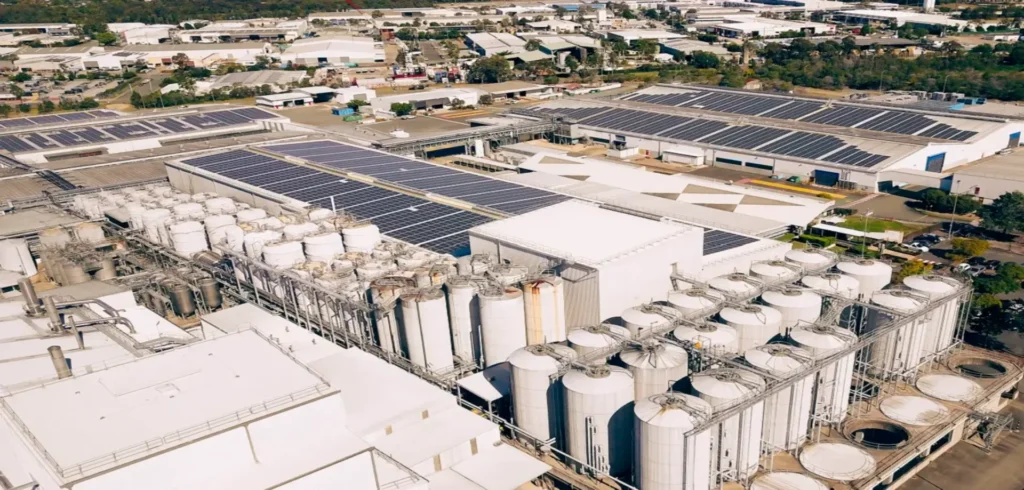
Breweries and distilleries are some of the best real-world candidates for solar. You’re running production equipment, refrigeration, pumps, lighting and often a visitor space too — all of which adds up to a hefty electricity bill. And because so much of that energy use happens during the day, solar panels can be a practical way to cut costs without changing the way your site operates.
In this guide, we’ve pulled together 10 solar panel options that work particularly well for breweries and distilleries — focusing on strong performance, reliability, and the kind of long-term value that makes commercial solar worth doing properly.
1. LONGi Hi-MO 6 (Hi-MO X6 / Scientist series)
Why it works for breweries & distilleries:
A strong choice when you want high output from limited roof space (common on sites with vents, ducts and plant). LONGi positions Hi-MO 6 Scientist as a high-performance module line.
Key specs:
- Hi-MO 6 Explorer datasheets commonly show 550–580W and efficiency figures around 22.5% (model dependent).
- Efficiency figures often quoted around ~22.5% on higher-end variants
- N-type cell technology used across Hi-MO 6 ranges
- Positioned for strong temperature performance versus older P-type modules
Cost & ROI: Good balance of performance and price for larger commercial rooftops.
Typical installation notes:
Commonly used on busy production roofs where output per square metre matters. Often paired with commercial string inverters and sometimes batteries to support early-morning and evening processing loads.
Things to consider:
Higher-performance modules need sensible inverter sizing. Best value where roof space is genuinely constrained.
2. JA Solar DeepBlue 4.0 Pro
Why it works:
A sensible commercial pick when you want a modern, high-output panel from a widely used manufacturer — helpful for bigger roofs and multi-building sites.
Key specs:
- Maxeon 6 series commonly shown around 425–440W
- Efficiency figures quoted up to ~22.8% (variant dependent)
- Uses interdigitated back contact (IBC) cell technology
- Documentation highlights 40-year warranty positioning (product availability varies)
Cost & ROI: Often selected for strong value at scale.
Typical installation notes:
Well suited to large, straightforward rooftops or multi-building sites. Often selected where consistency of supply and installer familiarity are priorities.
Things to consider:
Efficiency is solid rather than class-leading, so very tight roofs may benefit from higher-density options.
3. Trina Solar Vertex N (i-TOPCon)
Why it works:
If you’ve got a large, simple roof (or you’re considering ground-mount on spare land), high-wattage modules can help reduce the number of panels needed.
Key specs:
- Datasheets show outputs up to ~720W on selected variants
- Efficiency figures shown up to ~23.2% (variant dependent)
- Uses N-type i-TOPCon cell architecture
- Large-format module design aimed at high-capacity systems
Cost & ROI: Great when you’re building a bigger system and want fewer, higher-output modules.
Typical installation notes:
Frequently specified on large-span roofs or ground-mount arrays where high wattage helps reduce total module count. Works well for utility-style layouts.
Things to consider:
Large-format modules require early checks on roof layout, access, and mounting compatibility.
4. Jinko Tiger Neo (N-type, bifacial dual-glass options)
Why it works:
Bifacial (two-sided) options can be a good fit for ground-mount yards, carports, or reflective surfaces — which some production sites have.
Key specs:
- Tiger Neo bifacial dual-glass series commonly shown at 560–580W
- N-type TOPCon cell technology referenced across the range
- Bifacial construction available for ground-mount and carport use
- Dual-glass design positioned for durability and long service life
Cost & ROI: A mainstream, scalable option when you want something widely installed and straightforward to source.
Typical installation notes:
A good fit for ground-mount yards, carports, or reflective surfaces where bifacial gain can add value. Widely supported by UK installers.
Things to consider:
Bifacial uplift depends heavily on site conditions. Dual-glass variants add weight and should be checked against structural limits.
5. Canadian Solar TOPHiKu6 (N-type TOPCon)
Why it works:
Another strong commercial “all-rounder” when you’re balancing performance, availability, and bankable warranties.
Key specs:
- Datasheets commonly show 570–600W outputs
- Efficiency figures listed up to the ~23% range (model dependent)
- Uses N-type TOPCon cells
- Designed for large-scale commercial rooftops
Cost & ROI: Often a very sensible shortlist option for larger rooftops.
Typical installation notes:
Commonly shortlisted for larger commercial rooftops where reliability, availability, and predictable performance are key. Integrates easily with standard commercial systems.
Things to consider:
A balanced option rather than a specialist one — premium or ultra-high-wattage ranges may outperform in niche scenarios.
6. Qcells Q.TRON (incl. BLK variants)
Why it works:
If your brewery/distillery has a customer-facing roofline (taproom, shop, visitor centre), Q.TRON BLK variants are often chosen for a cleaner look — without giving up performance.
Key specs:
- Q.TRON BLK variants positioned up to ~22.5% efficiency
- Module ratings commonly shown up to ~440Wp (variant dependent)
- Clean, uniform black aesthetics on BLK models
- 25-year product and performance warranty positioning referenced in Qcells materials
Cost & ROI: A solid “smart-looking, high-performing” option.
Typical installation notes:
Often used on customer-facing buildings where appearance matters alongside dependable output. Suitable for mixed UK weather conditions.
Things to consider:
Lower wattage than some large-format commercial panels, so total output may be limited on very large roofs.
7. REC Alpha Pure-R
Why it works:
Great when roof space is tight or you want higher power density, especially on heritage or design-sensitive buildings where you want fewer panels overall.
Key specs:
- REC Alpha Pure-R series commonly spans 400–430W
- High-efficiency cell design aimed at strong power density
- Compact module format supports tighter roof layouts
- Low degradation positioning highlighted in REC documentation
Cost & ROI: More premium pricing, but can pay off where roof space and appearance are key.
Typical installation notes:
Well suited to heritage or design-sensitive buildings where fewer panels are preferred. Often paired with high-quality monitoring and long-life system design.
Things to consider:
Higher upfront cost makes it less suitable for large, low-visibility production roofs.
8. Maxeon 6 / Maxeon 6 AC
Why it works:
A premium choice when you want long-term reassurance and strong documented warranty positioning — useful for sites treating solar as a long-life asset upgrade.
Key specs:
- Maxeon 6 series commonly shown around 425–440W
- Efficiency figures quoted up to ~22.8% (variant dependent)
- Uses interdigitated back contact (IBC) cell technology
- Documentation highlights 40-year warranty positioning (product availability varies)
Cost & ROI: Higher upfront cost, typically justified by longevity positioning and premium performance.
Typical installation notes:
Typically chosen for flagship sites or long-hold ownership models. AC variants can simplify layouts on complex roofs where available.
Things to consider:
Premium pricing and variable availability mean early specification and installer experience are important.
9. Astronergy ASTRO N7 (commercial high-wattage options)
Why it works:
A practical commercial option when you want high-wattage modules suitable for larger rooftop arrays.
Key specs:
- Datasheets show 600–620W outputs on selected N7 variants
- Uses N-type cell technology
- Large-format modules designed for commercial rooftops
- Positioned for high output per module
Cost & ROI: Often shortlisted where value + high output per module matters.
Typical installation notes:
A practical choice for large rooftops where high wattage helps maximise output without increasing panel count too much.
Things to consider:
Less brand recognition than some peers, which may matter for conservative procurement teams.
10. First Solar Series 6 / Series 7 (thin-film)
Why it works:
Worth considering for larger ground-mount projects where you’re focused on long-term energy yield and performance in varied conditions. First Solar positions Series 6 around reliability and energy production, and Series 7 datasheets show high-wattage thin-film modules.
Key specs:
- Series 6 datasheets commonly show around 430–460W (variant dependent).
- Series 7 TR1 datasheets show around 505–540W and long-term degradation positioning (datasheet language varies by region/version).
- Uses thin-film technology rather than crystalline silicon
- Long-term degradation and energy yield positioning referenced in manufacturer materials
Cost & ROI: Usually a “bigger project” conversation — best suited where you’ve got land/space and want a utility-style approach.
Typical installation notes:
Best suited to ground-mount or large-scale projects where land is available and long-term energy yield is the priority.
Things to consider:
Generally not used on standard rooftops. Project economics work best at scale with appropriate land and grid access.
How We Picked the Panels on This List
| What we looked at | Why it matters for breweries & distilleries |
| Strong output on commercial roofs | Production sites often have big daytime demand — you want solar that makes a real dent in imports. |
| High output per panel | Fewer panels can mean simpler installs on busy roofs with vents and plant. |
| Reliability and long warrantie | You’re installing this to reduce running costs for years — it needs to be dependable. |
| Performance in mixed UK weather | Savings need to stack up across the whole year, not just in summer. |
| Options for roof and ground-mount | Many sites have multiple buildings, yards, or parking areas that can open up bigger systems. |
The Bottom Line
There isn’t one “perfect” solar panel for every brewery or distillery — it depends on your roof space, how your site runs day-to-day, and whether you’re planning for future growth (like more refrigeration, electrification, or EV charging). But what’s clear is this: when solar is designed properly, it can become a valuable business asset that keeps saving you money long after it’s installed.
Want expert advice on the best panels and the best system design for your site? Contact Perfect Sense Energy for a tailored recommendation and a clear next step towards solar for your brewery or distillery.
FAQs
Is solar worth it for breweries and distilleries?
Yes — often. These sites typically use plenty of electricity during daylight hours (refrigeration, pumps, production lines), which lines up well with when solar generates power.
Do we need batteries as well as solar?
Not always. If your main energy use is daytime, solar alone can deliver strong savings. Batteries are most useful if you want to use more solar in evenings/early mornings, support EV charging, or manage peak-time imports.
What’s better: rooftop solar or ground-mount for a brewery?
Rooftop is usually the simplest starting point if you’ve got decent roof area. Ground-mount can make sense if you want a larger system and have suitable land or yard space that won’t disrupt operations.
Will shading from vents and plant ruin performance?
It can reduce output if the design is poor — but it’s very common and manageable. A good layout (and the right electrical design) helps minimise shading losses.
How do we know what size system we need?
Start with two things: your daytime electricity use and your usable roof/land area. A proper design should aim to match generation to on-site use, so you’re saving money rather than exporting lots of power.