
Gyms and leisure centres don’t just use a lot of electricity — they use it constantly. From early-morning treadmills and evening classes to air conditioning, lighting and pool systems, the demand rarely lets up. That’s exactly why solar can be such a smart move: it helps you cut running costs, reduce reliance on the grid, and make your building more efficient without changing how you operate day-to-day.
In this guide, we’ve rounded up seven solar panel options that are particularly well-suited to gyms and leisure facilities — focusing on strong performance, long-term reliability, and the kind of output that makes a real difference to your bills.
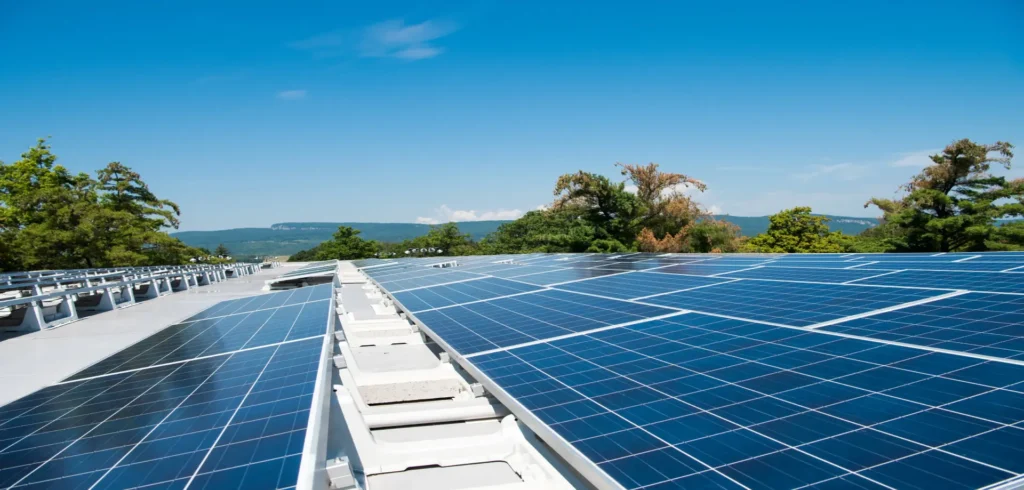
1. LONGi Hi-MO 6 Scientist (Hi-MO X6 Scientist)
Why it works:
If you’re space-limited (typical on busy roofs with HVAC units), you want high output per square metre. LONGi’s Hi-MO 6 Scientist line is positioned as a high-performance option, making it a strong fit for facilities trying to squeeze more generation from the same footprint.
Best for: Large roof arrays; sites prioritising high output per module.
Typical install notes:
- Works well alongside battery storage to shift solar into early mornings/evenings (peak gym times).
- String design should account for inverter clipping due to higher module output.
- Well suited to east–west roof layouts where spreading generation across the day matters.
- Allow sufficient access routes for future HVAC or rooftop plant maintenance.
Key considerations:
This panel suits operators focused on maximising onsite generation to offset daytime loads such as HVAC, pool filtration, and lighting. Its higher output density can be particularly valuable where roof access is constrained or future rooftop plant upgrades are likely.
Potential drawbacks / watch-outs:
Higher-performance modules typically come at a slightly higher price point than entry-level commercial panels. Careful system design is important to ensure inverter sizing and clipping are optimised for peak generation periods.
2. JA Solar DeepBlue 4.0 Pro
Why it works:
This range is commonly specified for commercial-scale systems where you want a reliable “workhorse” module with strong cost-to-performance. DeepBlue 4.0 Pro variants are widely referenced in high-wattage commercial configurations, which can help reduce balance-of-system costs on bigger rooftops.
Best for: Big, straightforward roof areas where you want strong value at scale.
Typical install notes:
- Often paired with commercial inverters and export-limiting where grid constraints apply.
- Straightforward mechanical mounting makes it efficient to install at scale.
- Ideal for uniform roof pitches with minimal obstructions.
- Common choice where procurement consistency and lead times matter.
Key considerations:
If your priority is predictable returns and proven commercial performance, DeepBlue panels are often favoured by installers and EPCs for their familiarity and availability. This can reduce project risk, especially across larger leisure estates.
Potential drawbacks / watch-outs:
Efficiency per square metre may be lower than premium modules, so sites with limited roof space may need to accept slightly lower total generation compared to higher-end options.
3. Trina Solar Vertex S+ (dual-glass, N-type i-TOPCon)
Why it works:
Leisure roofs can be hard on equipment: foot traffic for maintenance, wind uplift considerations, and the general wear-and-tear of plant-dense rooftops. Vertex S+ highlights a dual-glass design and explicitly calls out suitability for harsher environments (including sand/dust and ammonia resistance)—useful if you’re near roads, industrial areas, or have rooftop conditions that accelerate soiling.
Best for: Facilities wanting a durability-led choice (especially where the roof environment is tough).
Typical install notes:
- Dual-glass modules can be heavier—your installer should verify roof load limits early.
- Edge protection and handling procedures are important during install due to glass-on-glass design.
- Can benefit from slightly higher tilt angles to reduce long-term soiling.
- Often selected for sites aiming to minimise panel replacement over asset life.
Key considerations:
This is a strong choice for facilities with challenging rooftop environments, such as exposed locations or roofs with frequent maintenance access. The dual-glass build can support long-term resilience where operational disruption must be minimised.
Potential drawbacks / watch-outs:
The additional weight of dual-glass panels can limit suitability on older leisure buildings unless structural assessments confirm sufficient load capacity.
4. REC Alpha Pure-R (premium efficiency for limited space)
Why it works:
Many gyms don’t have endless clear roof area once you account for plant and safety zones. REC’s Alpha line is a popular “premium efficiency” pick in the market for projects where every panel has to pull its weight and long-term performance matters.
Best for: Premium builds, refurbishments, and sites with limited usable roof space.
Typical install notes:
- Particularly attractive when you’re trying to keep the number of panels lower (e.g., planning/aesthetics constraints) while still targeting meaningful generation.
- Works well with high-quality inverters and monitoring to maximise long-term yield.
- Suitable for constrained roofs where fire access routes limit array size.
- Often specified in refurb projects alongside roof upgrades or insulation works.
Key considerations:
REC Alpha panels align well with refurbishment projects where operators want high performance without visually overloading the roof. Their long-term degradation profile can also support business cases focused on asset value and sustainability reporting.
Potential drawbacks / watch-outs:
Upfront costs are typically higher, so payback calculations should account for long-term yield rather than short-term savings alone.
5. Jinko Solar Tiger Neo (N-type)
Why it works:
Gyms often want bankable, widely available modules that installers know well and can source reliably for larger jobs. Tiger Neo is commonly chosen in commercial contexts for that reason: it’s a scalable, mainstream N-type option suitable for roof or ground-mount where the site has car parks or adjacent land.
Best for: Multi-site operators standardising a spec across multiple locations.
Typical install notes:
- If your roof has partial shading, combine with optimisers or appropriate string design.
- Scales well across phased rollouts for multi-site operators.
- Compatible with most mainstream commercial mounting systems.
- Widely supported by UK installers, simplifying maintenance and spares.
Key considerations:
For chains and franchises, Tiger Neo supports consistency across multiple installs. Using the same module type can simplify procurement, maintenance planning, and performance benchmarking across sites.
Potential drawbacks / watch-outs:
As with many mainstream panels, performance is highly dependent on system design. Poor string layout or unmanaged shading can undermine otherwise solid module performance.
6. Qcells Q.TRON (strong low-light performance focus)+
Why it works:
The UK’s cloud cover and shoulder seasons make low-light performance a practical consideration. Qcells positions Q.TRON for solid energy yield in mixed conditions and it’s often selected when operators want a balance of performance, brand confidence and clean aesthetics (useful for leisure centres with visible roofs).
Best for: Customer-facing sites where appearance and predictable yield both matter.
Typical install notes:
- Consider a monitoring platform that turns solar performance into simple reporting for stakeholders (and marketing).
- Performs reliably on south-facing and mixed-orientation roofs.
- Good candidate for systems prioritising consistent monthly output over summer peaks.
- Often chosen where visual uniformity across a visible roof is important.
Key considerations for gym operators:
This option suits operators who value steady, year-round output rather than peak-only performance. It can support more stable generation profiles aligned with winter and shoulder-season gym usage.
Potential drawbacks / watch-outs:
While balanced in performance, Q.TRON may not deliver the highest peak output compared to premium efficiency modules on very sunny days.
7. Maxeon (SunPower legacy) Maxeon 6 / Maxeon 6 AC
Why it works:
If you’re going for a top-end spec with an emphasis on long-term reassurance, Maxeon’s documentation set highlights 40-year warranty positioning on Maxeon 6 products, with Maxeon 6 AC variants integrating microinverter-style architecture in the module offering (depending on region/product variant).
Best for: Premium facilities, flagship locations, and long-hold property owners prioritising longevity.
Typical install notes:
- Premium modules cost more upfront—often best justified where roof space is limited or brand/asset-life expectations are high.
- AC variants can reduce design complexity on roofs with multiple orientations.
- Ensure installer experience with microinverter-style architectures where applicable.
- Often paired with detailed performance monitoring for long-term assurance.
Key considerations:
Maxeon panels are often chosen where the solar system is treated as a long-term infrastructure asset rather than a short-term energy-saving measure. Integrated AC variants can simplify design on complex roofs.
Potential drawbacks / watch-outs:
Premium pricing means these panels are rarely the best option for cost-led projects. Installer familiarity with AC module architectures should also be confirmed early.
How We Picked the Best Solar Panels for Gyms and Leisure Centres
| What we looked at | Why it matters for gyms & leisure centres |
| Strong performance in the UK climate | You still get reliable savings on cloudy days and through winter, not just in summer |
| High output per panel | Useful when roof space is limited by vents, skylights, HVAC kit and walkways |
| Handles heat well | Panels perform better during warm spells when roofs get hot and demand can rise |
| Built to last | Gyms need tough, dependable kit that can handle wind, rain, dirt and wear |
| A good fit for commercial installs | Leisure sites need proven products that work well at larger scale |
| Good long-term value | We balanced performance, warranty and cost — not just the cheapest upfront option |
The Bottom Line
Choosing solar panels isn’t about picking the “most popular” option — it’s about finding what fits your building, your energy demand, and your long-term goals. With the right setup, solar can make a noticeable dent in operating costs while also improving your centre’s environmental impact (which customers increasingly care about too).
Ready to see what solar could look like for your site? Contact Perfect Sense Energy for expert advice, a tailored recommendation, and a clear plan for getting solar installed with confidence.
FAQs
Are solar panels worth it for gyms and leisure centres?
Yes, solar panels are usually worth it for gyms and leisure centres because they use a lot of electricity during the day, when solar generates the most power. This means you can use more of the energy you produce on-site, reduce your reliance on the grid, and cut running costs over the long term.
How many solar panels does a gym or leisure centre need?
Most gyms and leisure centres need dozens to hundreds of solar panels, depending on roof space, energy use, and whether you’re powering extras like pools or air conditioning. The best way to size a system is to match it to your building’s daytime electricity demand and how much usable roof area you have.
Do gyms need battery storage as well as solar panels?
Not always, but batteries can be a great add-on. A battery helps you store solar power generated during the day and use it later, which is useful for gyms with busy early-morning and evening peak times. If your site uses most energy during daylight hours, solar alone may already deliver strong savings.
Can solar panels work on flat roofs like most leisure centres have?
Yes — solar panels work very well on flat roofs. They’re typically installed on mounting systems that angle the panels for better generation, without needing to drill through the roof in many cases. A proper design will also make sure there’s space for roof access, maintenance and airflow around rooftop equipment.
What affects solar panel performance on gym and leisure centre buildings?
The biggest factors are roof space, shading, panel efficiency, and how much daytime energy you use. Things like rooftop HVAC units, vents, and nearby buildings can create shading, so a good layout and system design makes a big difference. That’s why choosing the right panel type — and the right installer — matters just as much as the panels themselves.