Solar panels are a great choice for your business. If you are searching for a way to reduce your electricity bills while also making use of clean, renewable energy, there is no finer choice that you can make than a solar installation.
Since this is a significant investment for any business, we will always encourage you to think about the full array. Sometimes, getting the panels is only the start. To truly harness the power of solar, companies may wish to consider adding solar panel battery storage to their systems.
Let’s go through everything you need to know about these special types of batteries.
What are solar battery systems?
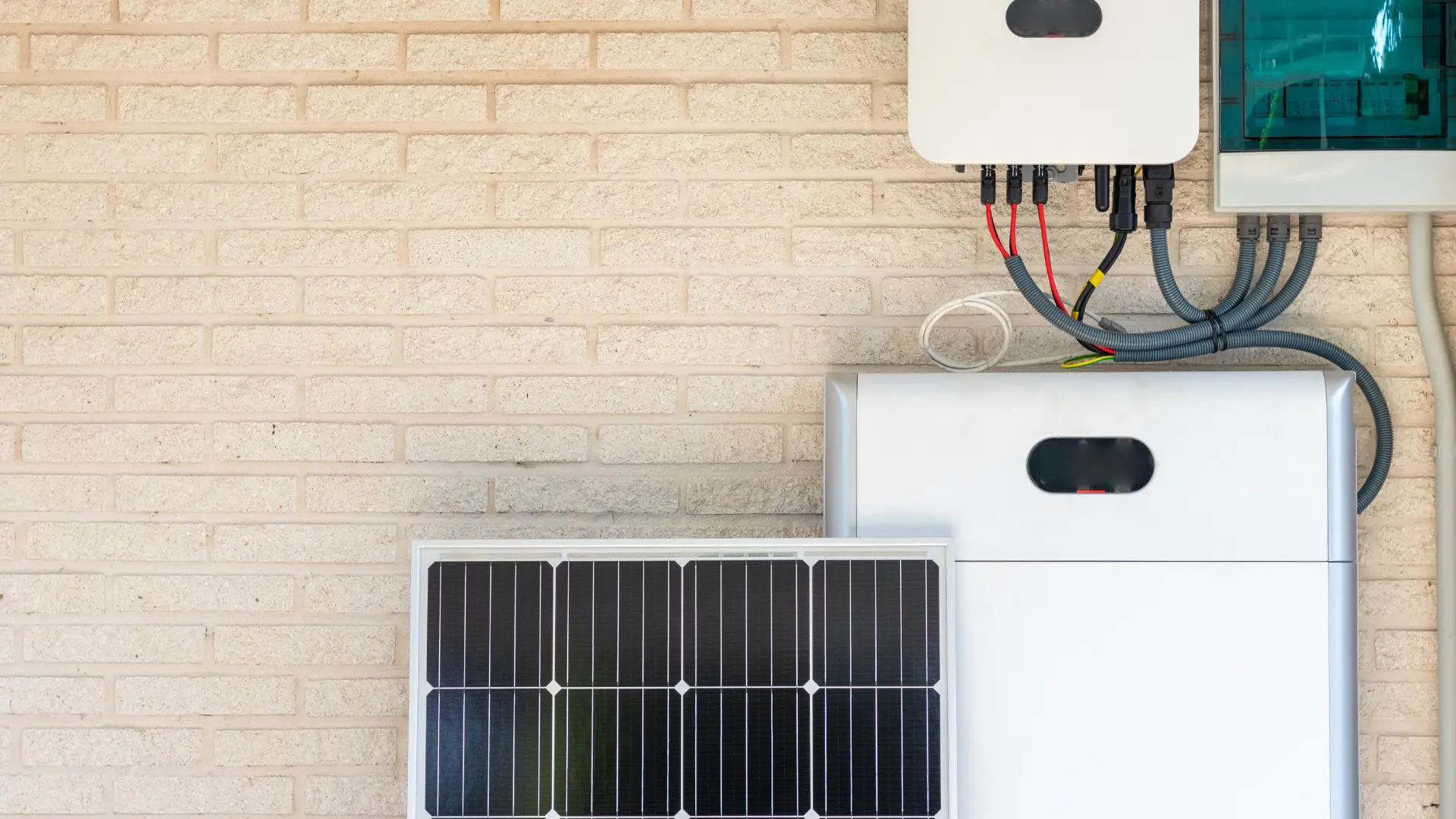
We’ve previously explained how solar panels work in detail, but if you need a refresher then all you need to know is that a current is generated within the panel that can then be harnessed for different purposes. This is direct current (DC) electricity, so you then need an inverter to convert it into alternating current (AC) to be used around your business.
However, your commercial solar panels will most likely be generating more DC energy than you could ever hope to use yourself. You could release this energy back into the grid, or you could store it yourself to use later when your system needs the extra electricity.
To do so, you obviously need a battery to store the electricity in. The rechargeable batteries used in solar arrays aren’t too different from a power bank you might use to charge your phone on the go; they are just made with slightly different materials for greater volumes of electricity.
What size of a system will I need?
The size of your battery installation will be tied to how many solar panels you have. If you have a smaller solar system with only a few panels, you will need fewer batteries than you would for an array that covers the roof of a sizeable warehouse.
The capacity of the batteries will depend on the size of the battery storage systems you choose to install. Many batteries can offer capacities of around 10kWH as a minimum. This means that the system should be able to exclusively provide power to the bare necessities for approximately 10 hours. If you have an emergency power outage, the excess energy stored in your batteries will hopefully be enough for you to power critical systems until full power can be restored.
Will a battery work with my existing solar panel system?
If you have already invested in a solar power system, don’t worry! Chances are that your existing system will be compatible with battery storage. Investing in an additional part of your solar array is possible, and Perfect Sense Energy can be your partner for this growth!
We can assess your current solar array and then make recommendations of options for your upgrades. All our work is carried out to industry standards, so you can be reassured that we will provide you with the best options for your budget and needs.
Most solar panel arrays are designed to be modular, so we should be able to add new sections to the system once we’ve taken a look at it. If we are installing your solar panels but you are not ready to commit to battery storage, we can still prepare the system to make battery installation as seamless as possible.
Where do the batteries go?
If you have limited space on the roof of your commercial property, you might have reservations as to where your batteries are going to go. Or, if you have an existing installation, you might think there is no room to add batteries.
In most scenarios, you will still be able to add battery storage to your system even if it appears you have no room on your roof. After all, it is not your responsibility to find the best location for battery storage—that is ours as your installer! We design our systems to suit your available space and work with the structural load capacity and limitations of your buildings.
What type of batteries should I choose?
You can choose from several solar batteries to best meet your needs. At Perfect Sense Energy, we recommend lithium-ion batteries and flow batteries.
Lithium-ion batteries have a high efficiency and a long lifespan. This makes them a great investment that should help support your energy consumption for a long time, just like your solar panels. They are also a great choice for regular discharge cycles. This means that you can easily draw energy from them regularly, so if you want to rely on your batteries regularly and not just for emergencies, lithium-ion batteries are a good choice.
The other option we recommend is flow batteries. These are more suited for larger storage needs but also allow for longer discharge periods. Some flow batteries can discharge for up to 10 hours, unlike lithium-ion batteries which have a shorter discharge period. Flow batteries are a great option for large-scale applications like utilities and microgrids, but they are also often used for charging electric vehicles (EVs).
Both are used for different applications, and key differences between them may also inform your decision when choosing between them. For example, a flow system takes up more space and will be more of an investment, but it can last longer than lithium-ion batteries. Conversely, lithium-ion batteries are more portable and offer large amounts of energy delivery. It all depends on what you need from your system; our experts will always ensure that your batteries meet your needs.
Do you save money with solar battery systems?
One major reason why companies begin to look into solar panels and additional systems like solar battery storage is to help with energy bills. The cost of electricity has risen for everyone. Investing in renewable energy like solar power now allows companies to future-proof and diversify their approach to powering their business.
A full solar installation is a serious investment that will require a lot of careful thought, but we offer plenty of financing options to help make the cost easier to manage. The true value of solar batteries and panels is in the value gained from them over time. A solar power system pays for itself and then provides a return on investment in the future. To see the savings that some of our customers have already made, take a look at our case studies.
Don’t forget your batteries!
Big or small, your solar panels may produce more electricity than you actually need. You need to decide what you will do with this excess energy generated. Though you may decide just to send it back into the grid (and there is nothing wrong with doing so!), choosing to store it for later use can also be beneficial.
Speak to us today about battery systems, whether you are already in conversation with us about solar panels or you are keen to expand your existing system with energy storage solutions.