How different can solar thermal vs solar photovoltaic (PV) panels be? They look pretty similar, and they both harness solar energy. In reality, they have some striking differences, and the one you go with will depend on your unique operational needs. If it makes sense, you may also decide to install both types of panels.
Here, we lay out exactly what solar thermal and solar PV systems are and how they compare across core business variables. By the end of this detailed guide, you should have the information you need to make your decision!
What is a Solar Thermal System? | What is a Solar PV System? |
| Solar thermal systems use solar thermal collectors (usually flat or slightly curved tubes embedded in panels) to capture heat from the sun. Once collected, that heat is transferred to a fluid (often water or a water–glycol mix) which then circulates through your property. The result? Warm water powered by sunshine. | A solar photovoltaic system is an energy infrastructure that harnesses sunlight via solar panels and converts it into electricity. This electricity can be sold to the grid, used immediately for heating and other energy needs, or stored using solar battery storage. |
Solar Thermal vs Solar PV Systems Comparison
From lower carbon footprint to cost savings, solar thermal and solar PV systems both win out over traditional energy solutions. But the question is, how do they compare to each other? Let’s get into what sets them apart, with comparisons on cost, efficiency, and installation requirements.
1. Cost and Payback Period
A core deciding factor between solar PV and solar thermal panels is, of course, cost. Here, we break down not only the upfront cost but also the payback period you can expect from each system type.
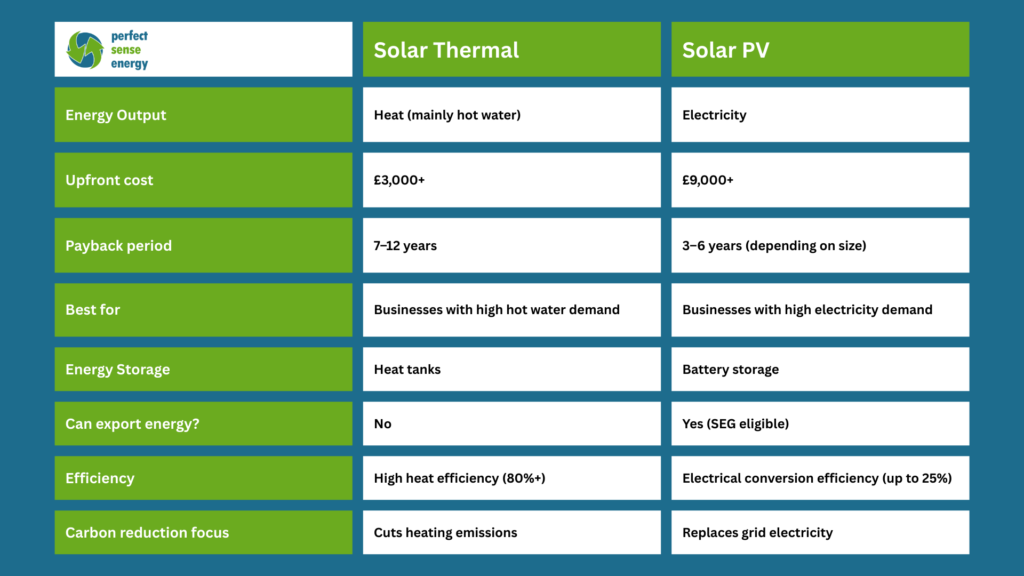
- Solar Thermal: A small premise, like a coffee shop, could expect to pay, on average, £4,500 for a 5m² thermal collector roof installation with a 250-litre cylinder. This is typically a lower upfront cost than PV systems, but the payback period is 7-12 years for commercial properties.
- Solar PV: An equivalent business site with a small 10kW system will pay in the range of £9,000-12,000. This is a higher initial investment, but with a payback period of only 5-6 years. Strong scalability means larger sites like industrial warehouses have a payback period of only 3-4 years.
While solar thermal is less expensive upfront, PV systems may offer broader financial returns due to the potential for battery storage, which allows for energy to be saved or sold to the national grid.
2. Installation
Installation is straightforward for both systems, with the main differences relating to property layout and the pre-existing technology installed on your premises.
- Solar Thermal: Requires suitable roof space for collectors and connection to your existing hot water system. For water heating, you will require a dedicated hot water cylinder. If you also wish to heat your space, you will need a heat store.
- Solar PV: Needs roof or ground space for panels; warehouses and car dealerships are ideal for this. You will also need the capacity to house an inverter to convert energy into usable electricity (and battery storage if desired).
With a reputable provider, both systems typically involve minimal disruption and can be installed within a few days or weeks, though exact timings will depend on the scale of your project.
3. Utility
The two solar technologies really start to show their personalities in the area of utility. Where one makes use of the sun’s heat, the other converts sunlight into versatile electricity.
- Solar Thermal: Built for one purpose, solar thermal focuses primarily on water heating. It can be used for space heating, though the applications for this are limited. It performs a single job and does it well, a bit like using a kettle to boil water rather than heating the whole house.
- Solar PV: Solar power in the form of electricity has many applications. It can power lighting, tech, appliances, and electric vehicles (EVs). Combine it with battery storage, and you can save power for later or sell it back to the grid with the Smart Export Guarantee (SEG) scheme.
Think of solar thermal as a finely tuned instrument, used for a specific performance. Solar PV, on the other hand, is a diverse studio setup.
4. Efficiency
When comparing solar thermal and solar PV, remember that each technology measures performance differently because they generate different types of energy.
- Solar Thermal: Highly efficient at trapping heat from the sun to use for water heating and known to exceed 80% efficiency in optimum conditions. The heat is lost unless it is used shortly after it is generated or stored in insulated heat tanks.
- Solar PV: Recent technology developments mean that top solar panels can operate at 25% efficiency. Commercial battery systems allow electricity storage for later use, enabling businesses to manage demand more strategically.
Ultimately, these efficiency figures measure different outcomes: solar thermal captures heat directly, while solar PV converts sunlight into electricity. The “best” option depends less on headline percentages and more on what kind of energy you actually need.
5. Carbon footprint
Both PV and thermal panels offer a cleaner way to power your organisation, cutting carbon at the source and reducing reliance on fossil fuels.
- Solar Thermal: Significantly reduces carbon emissions associated with water and space heating (by 153.5 million tons in 2025 alone!), helping to shrink one of the largest sources of energy use.
- Solar PV: Replaces carbon-intensive power with renewable generation on-site. For context, solar panels produce around 50g of CO₂ over their lifetime (a fraction of traditional energy sources).
If you want to reduce your business carbon footprint, either option can help. Solar thermal systems will likely have the biggest impact on organisations that require large volumes of water, such as healthcare facilities and hospitality businesses. If your primary demand is electricity, then solar panels might be your best choice.
Should You Choose Solar Thermal, Solar PV…or Both?
Both solar thermal and solar PV panels are a simple, efficient way to reduce energy bills and shrink your carbon footprint. In some cases, you may wish to combine them for optimum savings! The right choice depends on how your business uses energy. Here’s a simple way to decide.
Choose solar thermal if…
- Heating water is a major part of your energy costs
- You operate in sectors like hospitality, healthcare, or leisure
Choose solar PV if…
- You’re looking for faster payback and long-term flexibility
- Your main energy demand is electricity to power lighting and equipment
Consider combining both if…
- You have high electricity and high hot water demand
- You have the space to maximise on-site energy generation
- You’re working towards ambitious carbon reduction goals
Install Commercial Solar Panels for Your Business
While there may be use cases where solar thermal provides optimal performance, the versatility and ROI of solar PV systems make them by far the most popular renewable energy solution for businesses.
As of 2025, 40% of UK businesses have already taken control of their energy security by installing on-site solar. Are you one of them yet? See how solar panels could benefit your business specifically.
Get in touch today to arrange your no-cost desktop consultation.