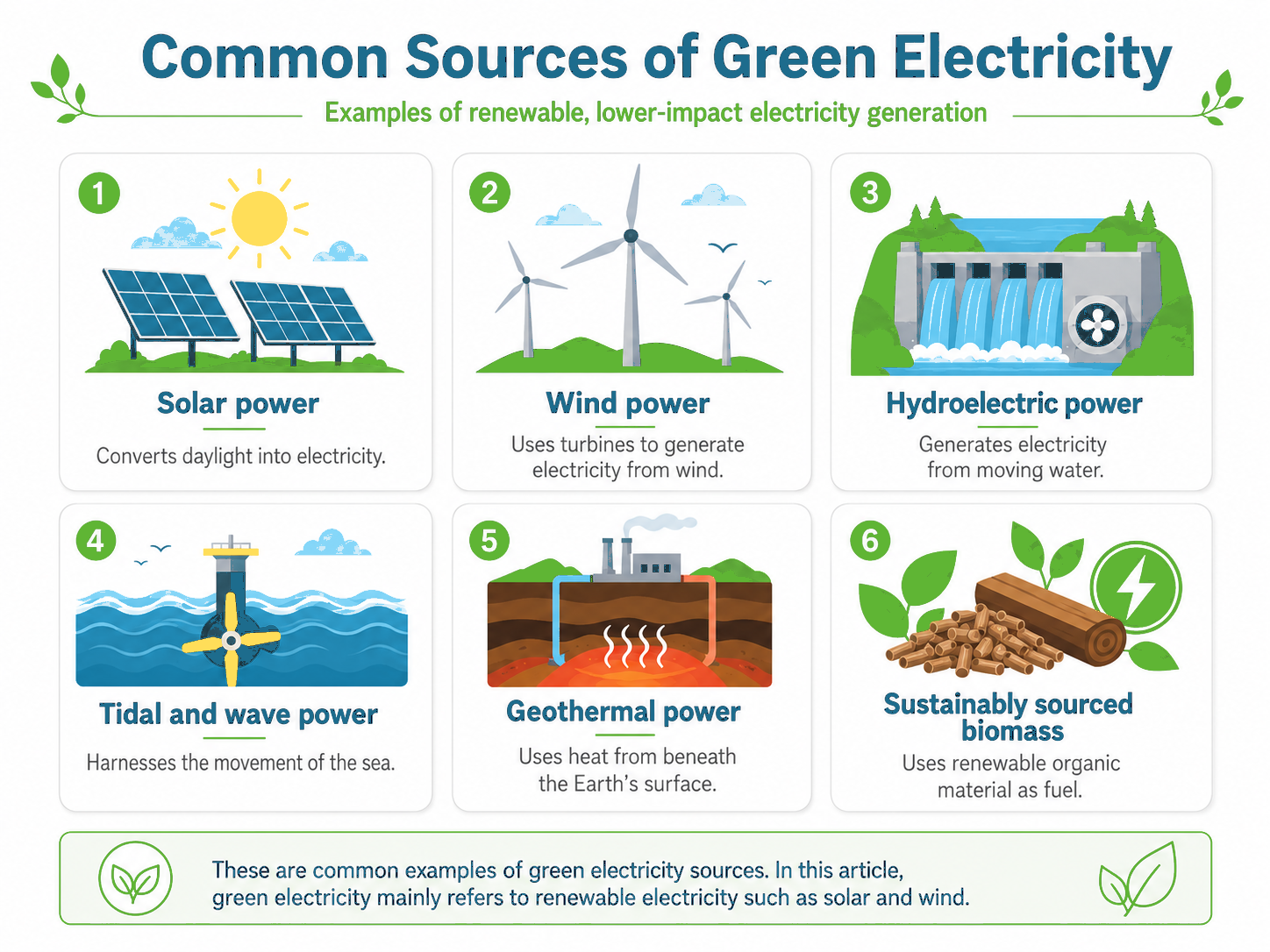

Do you want to improve your business sustainability, both financially and environmentally? You might want to begin by checking out the variety of renewable energy options available. Not all are created equal, with differing levels of efficiency and return on investment (ROI).
To take the guesswork out of it, we’re diving into precisely what constitutes renewable energy, the business benefits of going green, and different types of renewable energy, ranked by efficiency level. It’s worth going deeper than the numbers, though. When it comes to energy, there is more to the picture than meets the eye.
What is Renewable Energy?
Renewable energy is environmentally friendly power generated from naturally replenishing sources, as opposed to finite fossil fuels like oil and natural gas. The best-known examples are wind and solar power, but if you’re investing in new energy, it’s worth considering all the renewable energy technologies available.
At its core, this power comes from processes that are continuously occurring in the natural world. Sunlight, wind, flowing water, and heat from beneath the Earth’s surface can all be harnessed and converted. For businesses, this means access to energy that is not only cleaner but also more sustainable in the long term. Technologies such as solar panels, wind turbines, and heat pumps allow organisations to either generate their own energy onsite or source it from renewable suppliers.
Benefits of Renewable Energy for Businesses
The UK Public Attitudes Tracker showcased that 80% of people support the use of renewables for energy and heating. This may be because renewable energy production is better for the planet, but that isn’t where the benefits stop! Particularly for businesses, renewable energy brings a whole host of advantages that sing its praises.
Energy security
Geopolitical tensions, such as the wars in Ukraine and Iran, have had a knock-on effect on the availability of affordable energy for businesses. Renewable energy offers a way to take back control. With an alternative energy option (say, a biomass boiler for agricultural operations), your business will no longer be at the mercy of oil and gas shortages or the cost spike that inevitably comes with them.
Lower operational costs
One of the most immediate and tangible benefits of renewable energy is its impact on day-to-day running costs. By generating energy onsite or improving efficiency in general, businesses can reduce their reliance on grid electricity and protect themselves from rising prices.
In a recent Perfect Sense Energy project, for example, Hager UK installed a 98.4 kWp solar PV system at its Telford headquarters. The system is expected to generate over 94,000 kWh of electricity in its first year alone, resulting in savings of more than £20,800!
Revenue opportunities
If your business is in a position to generate electricity onsite via solar panels, you could also generate extra income via schemes such as the Smart Export Guarantee (SEG). An Ofgem report states that 270,395 installations benefited from this in 2024-2025, providing a total energy capacity of 1,585 MW.
Electric vehicle (EV) charging is another route to extra income, as in the example of solar carports. These innovative solutions allow organisations to produce essentially free sunshine energy, which they can then charge E-vehicle customers for.
Reduced carbon emissions
In 2023, the electricity sector produced the majority of greenhouse gases: a grand total 15.1 GtCO2e. Fossil fuels account for 60% of this electricity generation, according to a 2025 International Energy Agency (IEA) report. By comparison, renewable energy sources produce little to no greenhouse gas emissions (yes, even accounting for lifetime emissions during technology manufacturing and transport!). With rising greenhouse gases like carbon dioxide accelerating climate change, switching is now a no-brainer for environmentally conscious businesses.
Renewable Energy Sources by Energy Efficiency
So you have decided to transition to a more efficient energy solution. When comparing renewable energy sources, the first step is to define what “efficiency” actually means.
- For electricity generation, efficiency can mean either how much of the available natural energy is converted into electricity or how often the system generates close to its maximum output, known as its load/capacity factor.
- For heating technologies, efficiency is usually measured by how much usable heat is produced for every unit of energy consumed.
As each renewable technology works differently, the figures below are not necessarily like-for-like. Bear this in mind when reviewing them, along with how accessible the energy source is likely to be for the industry you work in. With that said, here is a breakdown of available renewable energy solutions.
Solar power
For many UK businesses, solar is still one of the most practical and cost-effective renewable technologies available, shining bright at around 15-20% efficiency. It works even on cloudy days, can make use of otherwise underused roof space (hello, warehouses!), and is relatively straightforward to install compared to wind or hydro.
Energy storage solutions, such as battery storage, can make solar power even more efficient. By storing excess energy generated during the day, businesses can use it during peak times or outside daylight hours.
Wind energy
Wind power is electricity generated by wind turbines, which can be either onshore or offshore. As of 2018, onshore wind farms had a capacity factor of 34%, compared to 43% for offshore. This is expected to increase to 30-55% and 36-58%, respectively, by the year 2030. Offshore wind farms are more efficient due to faster wind speeds out at sea, but with the exception of businesses that rely on a third-party provider or have extensive resources at their disposal, this may not be the most accessible option.
Ready for a breath of fresh air? Walkers successfully installed a wind turbine at their food manufacturing plant in the UK, which reduced their CO2 by 70% and produces 4,520 MWh of energy every year.
Geothermal energy
Geothermal energy draws heat from the earth. Between deep geothermal systems and ground source heat pumps, the latter is more accessible for UK businesses. Heat pumps operate close to the surface of the earth and can deliver three to four units of heat for every unit of electricity used. That means an efficiency of around 300% to 400%! By drawing on the earth’s natural heat, they can be used in combination with a boiler to provide a highly efficient hot water supply—a solid option for businesses looking to decarbonise heating specifically, rather than only electricity use.
Hydropower
In pure performance terms, hydropower is one of the strongest renewable technologies available, converting water flow into electricity with an impressive 70-90% efficiency rate. That said, hydro is also one of the least accessible options for many businesses. It depends heavily on location and a suitable water source, so while it performs well on paper, it is usually only realistic for very specific rural or land-rich sites.
Biomass energy
Biomass involves generating energy from organic materials such as wood pellets, agricultural waste, or food by-products. Given that burning the organic material produces only as much CO2 as the plant absorbed while it was growing, biomass is technically carbon neutral. One caveat: the organic material, e.g., trees, must be replanted to replace those that were used for fuel.
A wood-burning stove is a familiar example, but for most eligible businesses, biomass is more likely to take the form of a boiler or a combined heat and power (CHP) system. The efficiency rate of a biomass boiler ranges from 65-90%, depending on the boiler model and fuel moisture levels.
Which Renewable Energy Source is Best for UK Businesses?
We wish we could tell you the “best” renewable energy source, but it really depends on your unique business resources and needs. Hydropower, for example, delivers strong efficiency performance, but it is only viable in very specific locations. Wind can work well for larger organisations, as it typically requires more space and up-front investment. If your focus is heating rather than electricity, ground source heat pumps and biomass systems could be a good shout.
For the average UK business, however, solar is the most practical choice. It’s easy to install, works well on existing buildings, and can be enhanced with battery storage. Regardless of efficiency level, it is also one of the most affordable and scalable options. It’s no wonder that solar is the most popular in public opinion, with 86% of people saying they are supportive of it in the UK.
Invest in Commercial Solar Power for Your Business
If your business is ready to install solar panels, our experienced engineers are here to help out. Our team can assess your site, energy usage, and potential savings to give you a clear, tailored recommendation. With proven efficiency benefits and a payback period of only 3-4 years, making the switch to solar has never been more straightforward.
Reach out today for a no-cost desktop consultation, and see how solar panels can benefit your business.